Saturday, May 15, 2021

In the day after the Nagasaki atomic bomb exploded, the area around the Catholic Church of Nakamachi collapsed and burned down. The citizens of Nagasaki survived in only gathered together to search for their relatives and homes.

 In the early morning hours of August 10, 1945, the day after the Nagasaki atomic bomb exploded on August 9, 1945, the area around the Catholic Nakamachi Church collapsed and burned down after the bombing. It was located about 2.5 meters south-southeast of the hypocenter of the Nagasaki atomic bomb. The area was completely destroyed by a second fire and the whole area was burnt to the ground. The heat rays from the atomic bomb caused combustible materials to ignite and reignite, leading to a huge fire. The Catholic Nakamachi Church was destroyed by the atomic bombing of Nagasaki on August 9, 1945, leaving the outer walls and steeple.

 The situation in Nagasaki was different from other air raids in that the entire city was instantly turned into a blazing wasteland by the blast and the fire. Efforts to extinguish the fire and the medical team's efforts to rescue the victims were chaotic. As we waited for the time to pass, a small number of Nagasaki citizens who had survived because of their location gathered to search their homes and relatives. The Nagasaki atomic bomb was dropped at 11:02 a.m. on August 9, 1945, and exploded, killing or injuring about 120,820 people and setting about 18,409 houses on fire.

 At 11:02 a.m. on August 9, 1945, the explosion of the Nagasaki atomic bomb broke the windows of the cathedral and the interior collapsed due to the blast. A few hours later, the fire destroyed the roof of the cathedral, leaving only the steeple with the cross and the outer walls of the cathedral. Construction of the Nakamachi Church, located about 2.6 km south-southeast of the hypocenter, began in August 1981 with a donation from a French woman, and the dedication ceremony was held on September 8, 1897 to commemorate the 300th anniversary of the martyrdom of the 26 saints. The chapel is a grand Romanesque building with brick walls painted with cement, and the main entrance has a steeple with four large clocks, one on each side of the exterior walls.

 In October 1951, the church was rebuilt with its exterior walls and steeple intact. In October 1951, the church was rebuilt with its exterior walls and steeple intact, and as such, it has been designated by the city of Nagasaki as a valuable remains of the atomic bombing, and an inscription has been placed by the church gate. The city of Nagasaki installed the nameplate to pray for the souls of those who were killed in and around Nakamachi, Nagasaki, and to hope that such a horrific disaster will never be repeated.

 Yosuke Yamabata (1917-1966), a member of the press corps of the Army Headquarters, was transferred from Tokyo on August 1 to Fukuoka City on August 6. He had passed through Hiroshima City the night before, where a new type of atomic bomb was dropped and exploded on August 6. I arrived at Michinoo Station in the northern part of Nagasaki City at 3:00 a.m. on August 10. I stayed in Nagasaki City for about 12 hours and recorded about 115 photographs, which I developed on August 12 and took back to Tokyo after being advised by my colleague Shihei Hino that the military would destroy them. After the war, on September 9, GHQ imposed strict censorship on the press. After keeping it sealed for about seven years, the peace treaty with Japan came into effect on April 28, 1952, and on August 6, 1952, the atomic bomb photos were published in the August 6 issue of the Asahi Graph.


Saturday, May 8, 2021

On 25 July 1946, the United States conducted the first-ever underwater nuclear explosion at test Baker detonated at the Bikini Atoll in the Pacific Ocean.

On July 25, 1946, the United States conducted the first-ever nuclear explosion of an atomic bomb underwater. The Baker test, detonated at Bikini Atoll in the Pacific Ocean, was the fifth of more than 2,000 nuclear detonation tests conducted to date. Of these tests, only a few, such as the Baker test, were conducted with underwater explosions, primarily to assess damage to ships and submarines; with the exception of a few in space, such as the Starfish Prime test in 1962, about three-quarters of the tests were conducted primarily underground, with the remainder in the atmosphere.

 The device for the Baker nuclear test was suspended about 30 meters below the surface of the sea from beneath a ship; it detonated an atomic bomb equivalent to about 23 kilotons of TNT explosives. The Baker test followed the atmospheric Able test of July 1, 1946, both of which used the same type of protonium atom bomb as the Nagasaki bomb. They evaluated the effects of nuclear explosions on a fleet of ships and on animals by underwater detonation. Both the Baker and Able nuclear tests were part of Operation Crossroads, which involved the evacuation of approximately 42,000 personnel, 242 ships, 156 aircraft, and all 162 residents of Bikini Atoll.

 During the Baker test, all pigs and most rats aboard the ships died from the blast or from radiation exposure. Of the approximately fifty-seven target ships, about eight were severely damaged, sinking or capsizing as a direct result of the explosion. Most of the remaining ships were exposed to high radiation. Despite decontamination efforts such as wiping and spraying the decks, the high radioactivity remained. The Baker nuclear test produced considerably more radioactivity than the Able. Most of the remaining ships were subsequently unable to operate due to overheating and were forced to sink.

 It was not until 1947, the year after the Baker and Able nuclear tests, that a team of scientists and engineers conducted a scientific re-examination of the Bikini Atoll. Clearly, radiation had entered the Pacific food chain. Plankton glistened on the photographic dry plates. So did the intestinal tracts of the fish that ate them. Whether Bikini Atoll will return to the ecological balance it had before the Able nuclear test is uncertain in the short term. In 1998, almost 50 years and half a century after the tests, the International Atomic Energy Agency (IAEA) recommended that Bikini Atoll, where 23 nuclear tests had been conducted, should not be resettled without special radioactive decontamination. Residents of Bikini, Eniweck, Rongelap, and Utirik who were exposed to nuclear testing and radioactive contamination filed lawsuits against the U.S. government in the 1980's. The 1986 Free Association Agreement provides for compensation to the U.S. government for the health and environmental effects of nuclear testing.


On 25 July 1946, the United States conducted the first-ever underwater nuclear explosion at test Baker detonated at the Bikini Atoll in the Pacific Ocean.


Operation Crossroads (Baker Event 1946)

Saturday, May 1, 2021

On August 6, the atomic bomb is dropped on Hiroshima. Gen's father and siblings perish in the fires, but he and his mother escape.Hiroshima lies in ruins, and the city is full of people dead and dying from severe burns and radiation sickness.

 In Barefoot Gen "Vol. 1: The Appearance of Gen Aomugi", an atomic bomb was dropped on Hiroshima City by the U.S. Army on August 6, 1945 and exploded. Immediately afterwards, houses collapsed and burned, and the father, sister and brother, who were buried together and could not move, burned to death all at once. Barefoot Gen and his mother, who were left behind after the atomic bomb exploded, fled the area around the hypocenter, which had become a burning place with Hibakusha suffering from burns. Later, Barefoot Gen fled with his mother, who was carrying a newborn baby. Since the end of the war, he has lived through a variety of hardships.

 Nakazawa Keiji, the author of Barefoot Gen, used his own experience of the atomic bombing of Hiroshima in the first year of elementary school as the source of his long manga series in Shonen Jump, which depicted the harsh lives of atomic bomb survivors during and after the war, when the Hiroshima bomb exploded. Barefoot Gen was published at the end of the Pacific War, set in the aftermath of the Hiroshima atomic bombing and featuring second-year elementary school student Nakaoka Gen as the main character. The Nakaoka family, engaged in the manufacture of painted clogs, was very poor, and their five children grew up healthy during the war. However, when their father spoke out against the Pacific War, they were marginalized and discriminated against as unpatriotic, and were driven into the shadows. 

 Eventually, after the war, he met his eldest son, Koji Nakaoka, who had volunteered to join the Japanese army's preliminary training program, and his second son, Akira Nakaoka, who had been evacuated from his school. They were joined by Ryuta, an orphan who bore a striking resemblance to his younger brother, Shinji Nakaoka, who had been burned to death. The lives of the Hibakusha unfolded more fully, but the point of the manga was to depict the cruelty and misery of war through the reality of their miserable lives.

 The point of this manga is to depict the cruelty and misery of war through the realities of the Hibakusha's miserable lives. The younger generation after the war has no experience and ignorance of the mass abuse and genocide of war. They have been brainwashed with a distorted sense of war through television, movies, cartoons, and video games. The horrors and deprivations of war are not limited to the bursting of atomic bombs, shooting and air raids on the battlefield. Anyone who does not criticize, oppose, or actively cooperate with the war effort is discriminated against, ostracized, abused, and slaughtered. Moreover, the aftereffects of the war have left grievous wounds even after the war.

 Barefoot Gen never gave up and crawled through such circumstances during and after the war. The boy known as Barefoot Gen becomes the protagonist of the story, which depicts more poignantly the tragic lives of the atomic bomb survivors during and after the war, when the Hiroshima atomic bomb exploded. During the war, the Nakaoka family was evacuated from their surroundings as an unpatriotic family, and after the war, they were marginalized as outsiders. To the generation born after the war, which was completely indifferent and ignorant of the cruelty and misery of war, Barefoot Gen manga depicts war and peace in a small, light and gentle way.

 In 2005, at least, English, French, German, Italian, Korean, Russian, Spanish, Indonesian, Thai, Esperanto, Norwegian, and Polish editions of Barefoot Gen have already been published.

 The author, Nakazawa Keiji, talked about Barefoot Gen as follows. It's hard to draw a manga about an atomic bomb, but children can honestly discern what is true. That is why I continued to draw while relaxing and hoping that the children would be able to enter the work, rather than straining their shoulders. It is my hope that they will be able to grasp the real thing and understand what the atomic bomb is. 


Saturday, April 24, 2021

A 24-year-old survivor of the Hiroshima atomic bomb was exposed in the womb of his mother and suffered from severe intellectual disability due to microcephaly

Nobuko Kogusa, a 24-year-old girl who was exposed in utero to the Hiroshima atomic bomb, was born on March 7, 1946. Due to the explosion of the atomic bomb, the fetus, which had been in the mother's womb for about two months, suffered genetic damage caused by radiation. Microcephaly is a markedly small head circumference. Microcephaly, caused by early exposure to radiation from a short distance from the hypocenter, was recognized as an atomic bomb disease on September 7, 1967. It is accompanied by severe mental retardation, with a child's level of intelligence, which interferes with daily life and social activities. With multiple disabilities, he was born with a congenital deformity that resulted in the total loss of function of his right ankle joint. She is 24 years old, but her height is only about that of an elementary school student.

 Eighteen parents and supporters of children with microcephaly who were exposed to the atomic bomb in utero have formed the Mushroom Association at P.O. Box 119, Hiroshima City Naka Bureau. The Atomic Bomb Casualty Commission (ABCC), established by the U.S. during the occupation, published a paper in 1952 on 16 disabled children with A-bomb microcephaly. The ABCC, which investigated and studied microcephaly in children exposed in utero in Hiroshima, explained to parents of children suffering from A-bomb microcephaly that it was caused by malnutrition during pregnancy. In 1965, through research by the Hiroshima Study Group, the parties discovered a 1952 academic English paper that provided scientific evidence for A-bomb microcephaly, and in 1965, the Mushroom Association of 18 children and parents with A-bomb microcephaly was formed. In 1965, 18 children and their parents with A-bomb microcephaly formed the Mushroom Association, and in 1967, thanks to the social activism of those involved in the Mushroom Association and others, the Japanese government recognized the causal relationship between A-bomb microcephaly and the atomic bomb and issued an A-bomb Survivor Certificate.

 The name of the Mushroom Association comes from the phrase, "A life born under a mushroom cloud. Even if they live in the shade, we want them to grow up like mushrooms, pushing aside the fallen leaves" was the wish of the parents, children and supporters. The Mushroom Club for A-bomb Microcephaly suffered from the double discrimination of being an A-bomb survivor and a disabled person. 


Saturday, April 17, 2021

A 4-year-old girl was exposed to the atomic bomb in Hiroshima City, and a 16-year-old girl with burns and keloids left on her left face and both hands underwent plastic surgery at the Hiroshima Atomic Bomb Hospital.

The Hiroshima atomic bomb was dropped at 8:15 a.m. on August 1945, and the explosion exposed a huge number of Hiroshima citizens to the bomb. 4-year-old girl was exposed to the bomb in Hiroshima City, and was left with burns and keloids on her left face and hands. The exposed girl was admitted to the Hiroshima Atomic Bomb Hospital on May 12, 1957, at the age of 16, to have the remaining scarring sequelae reshaped. After being admitted, the burns and keloids were formed by a surgical transplantation of skin from her thigh.

   The girl, nicknamed Ms. Kintoki, was about 4 years old when she was exposed to the bomb while sitting on the porch of her home in Fukushima-minami, Hiroshima, about 2 kilometers from the hypocenter. She lost consciousness and became trapped underneath another house. He was rescued by a neighboring acquaintance, and on May 12, 1957, he was admitted to the Hiroshima Red Cross Hospital for plastic surgery. He underwent a total of nine plastic surgeries, including scars on his left neck, left anterior neck, and right elbow joint; after a skin grafting operation from his thigh to the affected area on October 21, he was strapped to the bed with a belt and cord because he needed absolute rest. Partial rest was not obtained and bleeding spots remained on the left cheek. The skin on both thighs was pulled off for grafting, and the scars remained and became ugly. On December 14, the girl was discharged from the hospital.

 In 1954, the Hiroshima Atomic Bomb Hospital received a portion of the profits from the 1955 New Year's postcard lottery. The Hiroshima Atomic Bomb Hospital was set up on the premises of the Hiroshima Red Cross Hospital, which opened on September 20, 1956. In Nagasaki, the Atomic Bomb Hospital was established in May 1958 with a portion of the profits from the New Year's postcards.  In 1957, there were many leukemia patients in the hospital's internal medicine ward and many young people undergoing plastic surgery for scars in the surgical ward; by 1967, the internal medicine ward was taking on more and more patients with malignant tumors and cancer.


Saturday, April 10, 2021

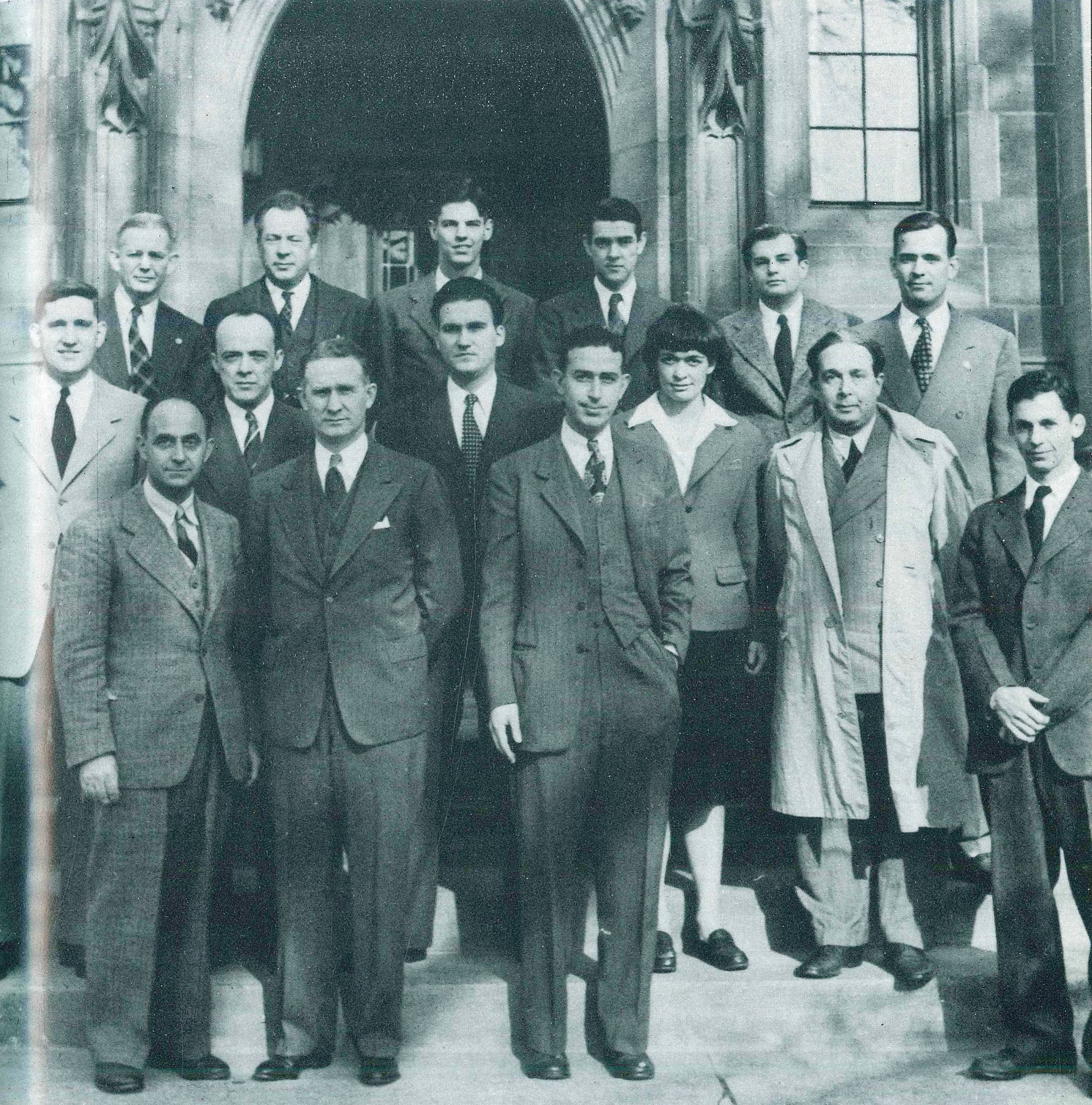
Reunion of atomic scientists on the 4th Anniversary (1946) of the first controlled nuclear fission chain reaction, December 2, 1942, pictured in front of Bernard A. Eckhart Hall at the University of Chicago.

 The CP-1 (Chicago Pile 1) reactor became the first reactor in human history to reach criticality and trigger a fission chain reaction on December 2, 1942, at the University of Chicago's experimental reactor, producing plutonium-239, the material used in the atomic bomb. On its fourth anniversary, December 12, 1946, CP-1 atomic scientists pose for a group photo in front of Bernard A. Eckhart Hall at the University of Chicago, where they won a glorious victory for their contribution to the atomic bomb. The U.S. had been based in Manhattan, New York since August 3, 1942, when a group of scientists and the military began secretly working together to test the atomic bomb. Shortly thereafter, CP-1 was incorporated into the Manhattan Project's development of the atomic bomb.

  The nuclear age began at 5:30 a.m. on July 16, 1945. A nuclear weapon exploded at Trinity, near Alamogordo, New Mexico. A prelude to the atomic bombings of Hiroshima and Nagasaki, which forced the surrender of Japan and ended World War II, the Trinity test was the culmination of a menacing devil's work by scientists, private industry, and the U.S. military to elicit atomic fission. During World War II, if Nazi Germany could have designed the first atomic bomb, Allied victory would have been almost lost. The U.S. Manhattan Project involved everything from a world war to a global war in order to design the world's first atomic bomb. From the clandestine origins of nuclear weapons at Oak Ridge, Hanford, and Los Alamos, the Manhattan Project unfolded until the day the U.S. military snatched victory from the Axis powers and won the war against Japan.

 At the pinnacle of nuclear weapons history, the Manhattan Project exploded Albert Einstein's famous equation E = MC2 against a staggering tyranny. In 1907, Einstein hypothesized an equation for the equivalence of mass and energy: energy (E) = mass (m) x speed of light (c) squared. In other words, he proved that any matter can produce an infinite and enormous amount of energy as the square of the speed of light. He suggested the birth of matter from the infinite and enormous energy of outer space. The Manhattan Project, which produced the atomic bomb, was led by scientist Robert Oppenheimer, who realized a working nuclear weapon on July 16, 1945. The project was actually manifested by President Roosevelt from a letter from Einstein and Leo Szilard. The Manhattan Project was the first project to set off a nuclear chain reaction, threatening the existence of the earth where atomic nuclei continue to split and explode.


Pioneers of the CP-1 (Chicago Pile 1) reactor reunited for their fourth anniversary in front of Bernard A. Eckhart Hall at the University of Chicago. Back row, left to right: Norman Hilberry, Samuel Allison, Thomas Brill, Robert G. Nobles, Warren Nyer Nyer, and Marvin Wilkening. Middle row: Harold Agnew, William Sturm, Harold Lichtenberger, Leona W. Marshall, Leo Szilard.) Front row: Enrico Fermi, Walter H. Zinn, Albert Wattenberg, and Herbert L. Anderson. 


Saturday, April 3, 2021

Patients waiting for death at the fire-damaged by Hiroshima Atomic Bomb in the Hiroshima Red-Cross Hospital August 10, 1945.

A large number of A-bomb survivors were admitted to the hospital aid station at a branch of the Army Hospital attached to the Hiroshima Red Cross Hospital. The number is not known, but a large number of the injured poured in, some with severe burns from the August 6, 1945, explosion of the Hiroshima atomic bomb, and others on the verge of death on August 10. The room was filled with dying Hibakusha with burns on their faces and bodies, unable to wear clothes. Groans filled the large room, and even the water at their bedside could not be reached by themselves.

 When the atomic bomb exploded on August 6, 1945, the Army Hospital Annex, which was attached to the Hiroshima Red Cross Hospital, was located about 1.6 kilometers south of the hypocenter. The three-story hospital ward was severely damaged, leaving the outer wall intact, but firefighting efforts prevented a fire. Only the exterior of the main building and other buildings remained, but the intense blast blew out the windows, and the interior of the building was a misery with debris scattered in the corridors. All of the X-ray films stored at the Hiroshima Red Cross Hospital were sensitized by the bombing, proving the radiation caused by the explosion of the atomic bomb. The city of Hiroshima was prepared for air raids, but the unprecedented explosion of the atomic bomb destroyed the city center, making it difficult to provide relief. First aid stations were set up in half-destroyed or slightly damaged national schools, temples, and private homes on the outskirts of Hiroshima.

 Immediately after the explosion, the Hiroshima Red Cross Hospital was flooded with a large number of survivors, and treatment began. The Hiroshima Red Cross Hospital and the Hiroshima Hospital of Communications and Communication, which had sustained relatively little damage and whose medical functions were still intact, became the bases for relief centers in the city center. Later, the Hiroshima Atomic Bomb Hospital was established on the premises of the Hiroshima Red Cross Hospital in Senda-machi, Naka Ward, Hiroshima City, with about 65 million yen from the distribution of profits from the New Year's postcards with New Year's gifts in 1954 and 1955, and opened on September 20, 1956. 


The keloids that had formed and swelled from the chest to the breasts of atomic bomb survivors exposed to the Nagasaki atomic bomb whose photographs were taken in February 1947 .

The keloid formation occurred on burned skin. Keloids that formed and swelled from the chest to the breasts of female atomic bomb survivors ...